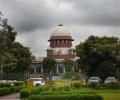
The Supreme Court of India will likely hear a batch of petitions challenging the constitutional validity of the Waqf (Amendment) Act, 2025 on April 15. The Act, which came into force on April 8, has been met with widespread criticism from various stakeholders, including politicians, the All India Muslim Personal Law Board (AIMPLB), and Jamiat Ulama-i-Hind. They argue that the law is discriminatory and violates the fundamental rights guaranteed under Articles 25 and 26 of the Constitution. The petitions allege that the amendments give the government more control over the administration of Waqf, effectively sidelining the Muslim minority from managing their own religious endowments.

'What has changed is that the new regulations are backed by a clear enforcement framework. They have real consequences and, for the first time, make compliance unavoidable.'

'Women in crime can turn on and off emotions like a tap.' 'Something that comes in the way of their goals can be eliminated without a second thought.'

Union minister Giriraj Singh's controversial remarks regarding the 'naqab' incident in Bihar have drawn criticism from opposition leaders, escalating the political row.

Underscoring the 'presumption of constitutionality in favour of law', the Supreme Court on Tuesday said petitioners challenging the waqf law needed a 'strong and glaring' case for interim relief.

RSS chief Mohan Bhagwat stated he will continue in his role despite his age, stepping down only when the organization directs him to do so. He also discussed the importance of values and communication within the RSS.
The Supreme Court denied bail to activists Umar Khalid and Sharjeel Imam in the 2020 Delhi riots conspiracy case, citing prosecution material suggesting their involvement in planning and strategic direction. The court granted bail to other activists but emphasized the seriousness of the allegations against Khalid and Imam.

Several petitions were filed in the apex court challenging the Act, contending that it was discriminatory towards the Muslim community and violated their fundamental rights.

A three-judge Supreme Court bench will hear petitions challenging the constitutional validity of the Waqf (Amendment) Act, 2025, on April 16. The petitions, including those by politicians and the All India Muslim Personal Law Board (AIMPLB) and Jamiat Ulama-i-Hind, were filed in the top court challenging the validity of the newly-enacted law. The Centre has filed a caveat in the apex court, seeking a hearing before any order is passed.
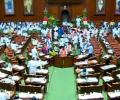
The Karnataka Legislative Assembly passed a Bill providing 4% reservation for Muslims in public contracts, sparking protests from the opposition BJP. The Bill, which amends the Karnataka Transparency in Public Procurements (KTPP) Act, aims to increase Muslim participation in government contracts valued up to Rs 2 crore for civil works and Rs 1 crore for goods and services. The BJP criticized the move as unconstitutional and vowed to challenge it in court.

Congress General Secretary Rahul Gandhi on Sunday called on All India Muslim Personal Law Board chief Maulana Rabe Nadwi, further indicating the party's intent to woo Muslims in view of the 2012 state assembly elections.

Kis Kisko Pyaar Karoon 2 may be a comedy filled with chaos, but in its indirect way, it speaks about a time when the Constitution mattered more than one's religion and when the idea of India was larger than personal hate, observes Syed Firdaus Ashraf.

'The courts should not dishearten the people that might end the hope of last justice'

Introducing the bill, Rijiju said the consultation process of the Joint Parliamentary Committee (JPC) was the largest ever exercise carried out by a parliamentary panel in India's democratic history.
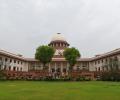
The Indian government has defended the Waqf (Amendment) Act, 2025 in the Supreme Court, arguing that there cannot be a blanket stay on the law as there is a presumption of its constitutionality. The Centre countered the pleas challenging the law's validity, asserting that the amendments were undertaken after a comprehensive study by a parliamentary panel. The government also highlighted the "reported misuse" of earlier provisions and the increase in waqf land, claiming that over 20 lakh hectares were added after 2013.

The Kerala High Court has stated it cannot accept multiple marriages of a Muslim man when he cannot maintain his wives, especially when one seeks maintenance. The court's observation came during a case where a woman sought maintenance from her husband who survives by begging.
Taslima, in her article titled 'Let's Burn The Burqa,' criticised the wearing of veils and asked Muslim women to 'throw away the apparel of discrimination and burn their burqas.'
Even as the All India Muslim Personal Law Board on Saturday unanimously resolved to take the Ayodhya battle to the Supreme Court, it sought to clarify that the board was not opposed to an out-of -court compromise, albeit with certain pre-conditions.

The Madhya Pradesh high court has dismissed a petition filed by Shah Bano Begum's daughter seeking to stop the release of the Hindi film Haq, inspired by her mother's famous legal battle, holding that a person's right to reputation or privacy is not heritable.

The Supreme Court on Friday refused to entertain a fresh plea challenging constitutional validity of the Waqf (Amendment) Act, 2025.

The Madhya Pradesh High Court dismissed a petition seeking a stay on the release of the Hindi film 'Haq', which is inspired by the life and legal struggle of Shah Bano Begum. The court found the petition devoid of merit, clearing the way for the film's release.

The Muslim Law Board contended that Uniform Civil Code, if implemented, will paint all people in "one colour" which will threaten the country's pluralism and diversity.
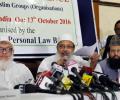
When the Muslim Personal Law Board promises 'advisories' and nikahnamas to the Supreme Court, one has to remember not only its recent campaign against any change in Muslim personal law, but also its past record of inaction on the question of triple talaq, says Jyoti Punwani.
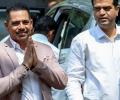
Congress leader Sonia Gandhi's son-in-law Robert Vadra has triggered a row with his comments suggesting that non-Muslims were attacked in Pahalgam because terrorists feel Muslims are being "mistreated" in the country. The BJP has accused him of using the language of terrorists and demanded an apology. Vadra condemned the Pahalgam terrorist attack but suggested that communal issues and a feeling of vulnerability among minorities are contributing to the violence. He said it is time to separate politics and religion and called for introspection by political parties. Vadra's remarks have been met with strong condemnation from the BJP, which accused him of playing politics on the issue and demanded a clarification from the Congress party. The BJP has also criticized Vadra for justifying the actions of terrorists.
Professor Sulaiman, who has been on the board's core committee, told this correspondent that the final copy of their appeal is more or less ready

Authorities in Kashmir have initiated a profiling process of mosques, madrassas, and individuals associated with their management following the exposure of a 'white collar' terror module. The enumeration drive focuses on the finances of these institutions and the backgrounds of their personnel.
Calling for an 'enlightened debate' on Uniform Civil Code, Information and Broadcasting Minister M Venkaiah Naidu said the 'real mood' of the country was to end triple talaq and some people were trying to create confusion over the two issues.

The Centre on Wednesday told the Supreme Court that nobody can claim right over government land and it is legally empowered to reclaim properties which are declared waqf by using the waqf by user principle.

Aseem Chhabra ranks the Best of 2025's films that released in theatres, or went directly to OTT platforms.

'Why would a highly qualified doctor with a promising future choose to wage war against his own country?'
"Any marriage in Islam is certified by three people including a Kazi, and there is no need for any other certification. Muslims are governed by their own rules which are different from the rules of other communities," a member of the New All-India Muslim Personal Law Board said.

'In times of adversity, families unite, but the reverse is happening in the Lalu family.'
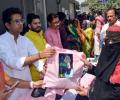
'During Eid Muslims get Eidi, but Opposition parties never gave that to them.' 'When PM Modi is giving Eidi to Muslims Opposition leaders are getting upset.'

Delhi Police strongly opposes bail pleas of activists Umar Khalid, Sharjeel Imam, and others in the February 2020 riots case, claiming it was a pre-planned attack on the nation's sovereignty and an attempt to divide society on communal lines.
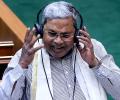
The Karnataka government has tabled a Bill in the Legislative Assembly to introduce a 4 per cent reservation for Muslims in public contracts. The Bill aims to address unemployment among backward classes and promote their participation in government construction projects. The BJP has called the move an "unconstitutional misadventure" and vowed to oppose it.

'I wanted to go for the heart, and at the same time, open the audience's mind.'

'Whatever Shami did was right, and there is no need to pay attention to these things. He should focus on the final match and forget all these things.'

A bench of Justice Vikas Bahl heard a habeas corpus petition of Javed (26), seeking custody of his 16-year-old wife who was kept at a children's home in Haryana's Panchkula.

Union Home Minister Amit Shah criticizes Kerala's ruling Left government over the Sabarimala gold loss case, demanding a neutral investigation and accusing the government of protecting the real culprits. He also signals the start of the BJP's campaign for the upcoming Assembly elections.
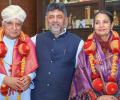
Karnataka Deputy Chief Minister D K Shivakumar denied on Monday making any comments regarding changing the Constitution to accommodate four per cent reservation for Muslims in the state. He claimed he was "misquoted" and warned of moving a breach of privilege motion. Shivakumar's remarks came after the BJP forced repeated adjournments in the Lok Sabha over his alleged comments on the matter. The BJP has accused Shivakumar of seeking to change the Constitution for political gain, highlighting the ongoing controversy surrounding reservation policies in India.
